
Choose the Right Glass Wafer for Microfluidics
Selecting the correct borosilicate glass wafer is essential for achieving reliable microfluidic performance. Properties such as thermal expansion, surface quality, and chemical resistance directly impact bonding strength, channel precision, and device durability.
Quick Facts for Microfluidic Engineers
- Excellent chemical resistance for lab-on-chip systems
- High optical transparency for imaging and detection
- Compatible with silicon for anodic bonding
- Common wafer sizes: 100 mm and 150 mm
Get Your Quote FAST! Or, Buy Online and Start Researching Today!
Related Glass and Microfluidic Substrate Pages
- Glass Wafers for MEMS and Microfluidics
- Microfluidic Substrates
- Silicon Wafers
- Soda Lime Glass Substrates
- Borofloat 33 Glass Wafers
- Corning Eagle Glass
- Quartz and Fused Silica Wafers
- BK7 Glass Substrates
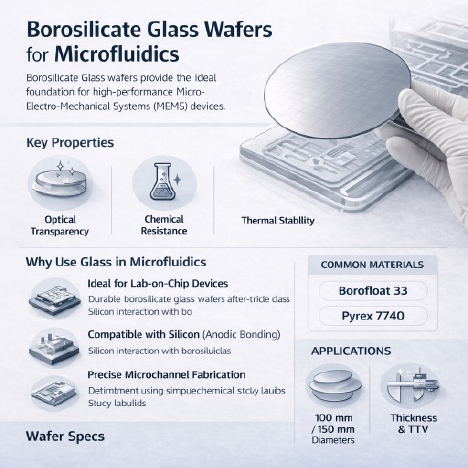
Borosilicate Glass Wafers for Microfluidic Device Fabrication
Borosilicate glass wafers are widely used in microfluidic device fabrication due to their excellent optical clarity, chemical resistance, and thermal stability. Compared to other materials, these wafers provide reliable performance in lab-on-chip systems and MEMS devices, especially when paired with
Researchers and engineers often select
Why Borosilicate Glass is Used in Microfluidics
Microfluidic devices require materials that can withstand chemical exposure while maintaining optical visibility for analysis. Borosilicate glass wafers meet these requirements, making them a preferred choice for biological, chemical, and analytical systems.
- High optical transparency for imaging and detection
- Strong chemical resistance for lab environments
- Thermal stability for bonding and processing
- Low surface roughness for precise microchannels
Glass-Silicon Bonding for Microfluidic Devices
One of the key advantages of borosilicate glass is its compatibility with silicon in bonded microfluidic devices. Through anodic bonding, glass wafers can be sealed with >silicon substrates to create enclosed microchannels used in lab-on-chip systems.
This combination allows engineers to integrate electrical functionality from silicon with the optical and chemical advantages of glass. Many MEMS and microfluidic platforms rely on this hybrid structure for improved performance and reliability.
Common Types of Glass Wafers
Different glass materials are used depending on the application. Borosilicate glass is the most common, but other materials may be selected for specialized optical or thermal requirements.
In addition to borosilicate options, engineers may consider quartz and fused silica wafers for higher optical performance or BK7 glass substrates for general optical applications.
Wafer Sizes and Specifications
Selecting the correct wafer size and specifications is essential for successful fabrication. Many research labs use standard wafer diameters that are compatible with photolithography and MEMS processing equipment.
- Common diameters: 100 mm and 150 mm
- Thickness varies based on device requirements
- Surface polish options for bonding and patterning
- Flatness and TTV for precise fabrication
Applications of Borosilicate Glass Wafers
Borosilicate glass wafers are used in a wide range of applications where optical clarity and chemical resistance are essential.
- Microfluidic lab-on-chip devices
- Biomedical and chemical analysis systems
- MEMS sensors and actuators
- Optical inspection and imaging platforms
- Silicon-glass bonded microdevices
As microfluidics and MEMS technologies continue to evolve, borosilicate glass wafers remain a key material for enabling precise, reliable, and high-performance devices in both research and industrial applications.