
Fused Silica Material Properties and Wafer Specifications
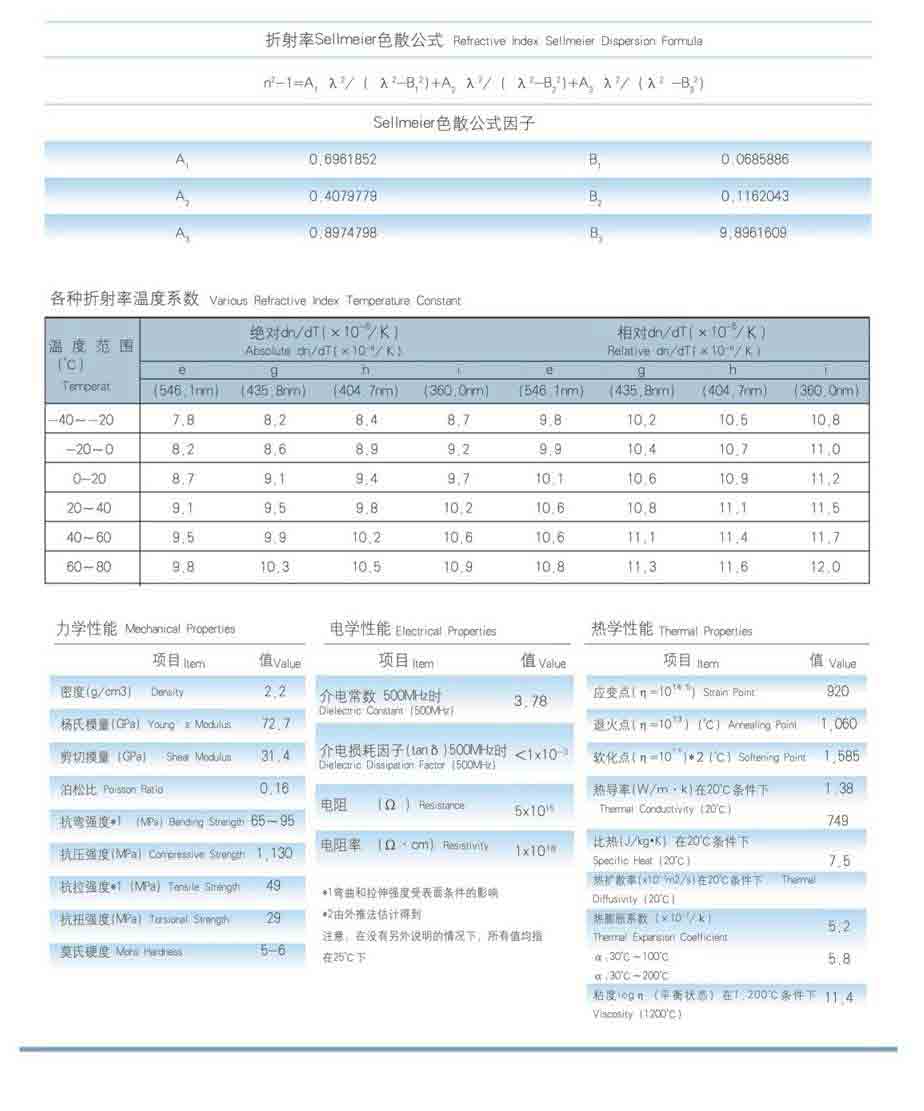
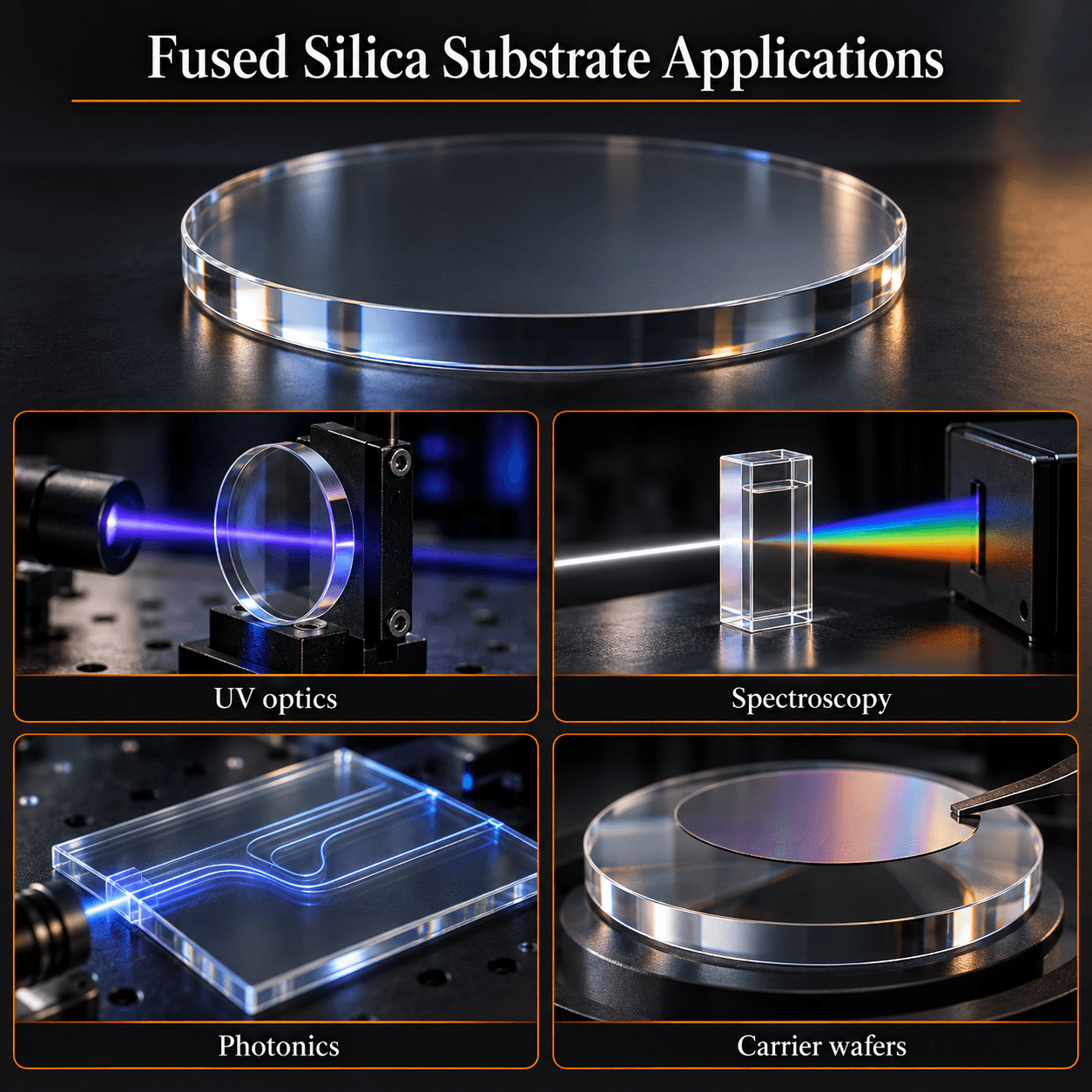
UniversityWafer supplies JGS1 and JGS2 fused silica wafers, substrates, optical windows, and custom-fabricated components for research, photonics, semiconductor processing, spectroscopy, and high-temperature applications. Specify the operating wavelength and review the supplier's transmission curve, refractive index, thermal expansion, and surface quality before selecting a grade.
Whether you need a single prototype or production quantities, we can provide custom diameters, thicknesses, polishing options, and edge profiles to meet your application requirements.
Get Your Quote FAST!
Understanding Fused Silica and Quartz
These SiO₂ materials differ in structure and sometimes in how suppliers name them:
- Single-crystal quartz is crystalline SiO₂ with direction-dependent optical properties.
- Fused silica is noncrystalline (amorphous) SiO₂ glass; high-purity synthetic grades are common in UV optics.
- Fused quartz also describes amorphous SiO₂ glass, often made from natural quartz feedstock. Suppliers may use the names differently, so confirm the grade and datasheet.
If you're unsure whether your application requires JGS1 fused silica, JGS2 fused silica, fused quartz, or single-crystal quartz, our technical team can help identify the most suitable material for your optical, semiconductor, laser, or research application.
JGS1 and JGS2 Fused Silica Material Properties
JGS1 vs. JGS2: Optical Grade Selection
Both grades are amorphous SiO₂ glasses with low thermal expansion and useful optical transmission. The grade designation alone does not guarantee performance at every wavelength; compare the transmission curve for the specific material and thickness you plan to use.
- JGS1 fused silica: a typical choice for deep-UV and visible optics, including UV windows, spectroscopy and optical research. Check the supplier's specified transmission at the exact UV wavelength.
- JGS2 fused silica: commonly used for visible and near-infrared windows, carrier wafers, and laboratory substrates. For demanding deep-UV work, compare its short-wavelength transmission with JGS1.
The useful range and transmission vary with source material, hydroxyl (OH) content, inclusions, finish and optical path length. For an infrared application, request a curve at your working wavelength; OH-related absorption can matter around 2.7 µm. For applications that prioritize infrared transmission, also review JGS3 fused silica.
Thermal and Physical Properties
Fused silica's low coefficient of thermal expansion, approximately 0.55 × 10⁻⁶/°C over a commonly specified temperature interval, helps maintain dimensional stability through temperature changes. It also offers good electrical insulation and resistance to thermal shock. Confirm grade-specific values and processing limits against the supplied datasheet.
What to Specify for Fused Silica Wafers
- Grade (JGS1 or JGS2) and required transmission at the operating wavelength
- Diameter, thickness, tolerance, flatness and edge profile
- Single- or double-side polish, surface roughness and scratch/dig limits
- Any requirements for OH content, inclusions, homogeneity or thermal cycling
- Quantity and intended optical, MEMS or semiconductor application
Fused Silica vs. Crystalline Quartz
Fused silica is amorphous SiO₂, while single-crystal quartz has an ordered crystal structure. If a design calls for a particular crystal orientation or birefringence, specify crystalline quartz; for an isotropic glass optical substrate, request fused silica with the required grade and transmission curve.
For a quote, provide the grade, diameter, thickness, polish, operating wavelength and quantity using the form on this page.