
Request a Quote
Looking for the right silicon wafer for your solar cell application? Whether you need N-type, float zone, or solar-grade substrates, our team can help you find the exact specifications for your research or production needs.
Get Your Quote FAST! Or, Buy Online and Start Researching Today!
Related Internal Links
- Solar Wafers
- Float Zone Silicon Wafers
- Prime Grade Silicon Wafers
- Silicon Wafer Properties
- How to Choose Silicon Wafers
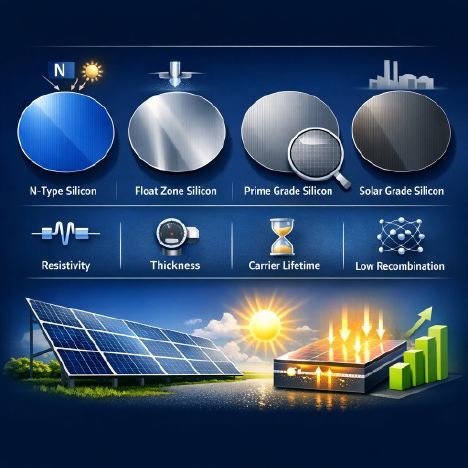
Best Silicon Wafer Grades for High Efficiency Solar Cells
High efficiency solar cells rely heavily on the quality, purity, and electrical properties of the silicon substrate. Selecting the correct wafer type is critical for improving carrier lifetime, minimizing recombination losses, and enabling advanced photovoltaic structures such as TOPCon and heterojunction cells. silicon used in solar applications are carefully engineered to meet strict requirements for resistivity, thickness uniformity, and defect density.
N-Type Silicon Wafers for Solar Efficiency
N-type silicon wafers are widely used in high-performance solar cells due to their resistance to light-induced degradation (LID). Unlike p-type substrates, n-type wafers maintain stable performance over time, making them ideal for long-term photovoltaic applications. Manufacturers often choose n-type silicon wafers for advanced designs such as TOPCon and heterojunction (HJT) solar cells, where high minority carrier lifetime is essential.
Float Zone Silicon for Advanced Solar Research
For research and next-generation solar technologies, ultra-high purity substrates are required. Float zone silicon wafers offer extremely low oxygen content and superior electronic properties compared to Czochralski-grown wafers. These wafers are ideal for studying new photovoltaic concepts, including high-efficiency lab-scale solar cells and experimental doping structures.
Prime Grade Silicon Wafers for Precision Applications
When uniformity and surface quality are critical, prime grade silicon wafers provide tight control over thickness variation (TTV), surface roughness, and defect density. These wafers are commonly used in both solar research and semiconductor fabrication, where precise processing and reproducibility are required.
Solar Grade Silicon Wafers for Large-Scale Production
In commercial photovoltaic manufacturing, cost-effective substrates are essential. solar wafers are optimized for large-scale production, balancing efficiency and affordability. While they may have higher impurity levels than prime or float zone wafers, they are suitable for mass production of solar panels used in residential and industrial energy systems.
Key Wafer Properties That Impact Solar Cell Performance
Several wafer characteristics directly influence solar cell efficiency, including resistivity, thickness, crystal orientation, and impurity concentration. High-quality thin silicon wafers can reduce material costs while maintaining performance, especially when combined with advanced cell architectures. Additionally, controlling parameters such as bow, warp, and total thickness variation ensures consistent processing and device reliability.
Choosing the Right Silicon Wafer for Your Application
The choice of wafer depends on the specific application, whether it is high-efficiency research, pilot-scale development, or mass production. Researchers often prioritize purity and carrier lifetime, while manufacturers focus on scalability and cost. Understanding the differences between wafer types allows engineers to optimize device performance and achieve higher energy conversion efficiency in solar cells.